
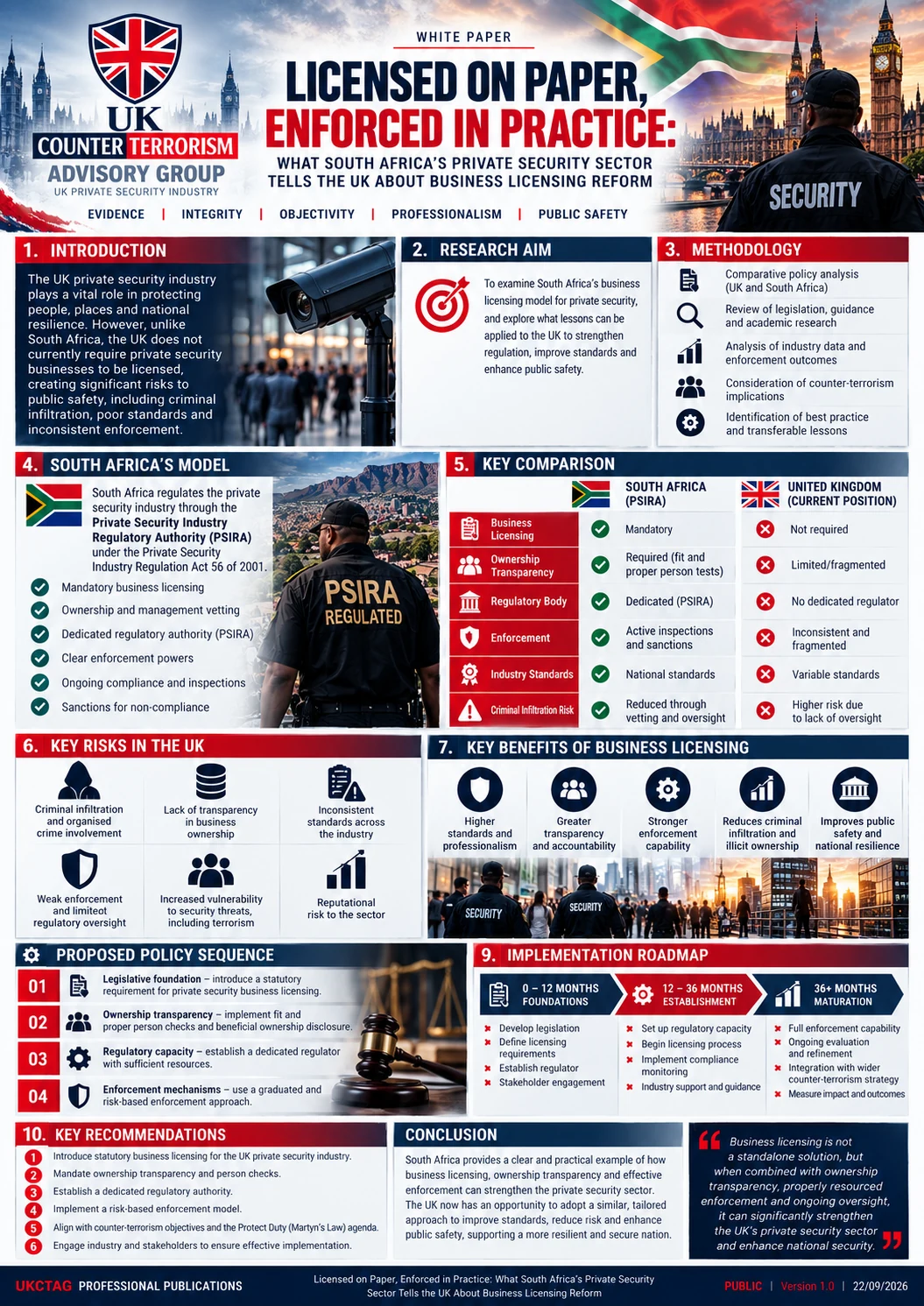
A necessary reform — but not a standalone solution.
South Africa's registered private security sector provides a clear cautionary case. A company accredited by the Private Security Industry Regulatory Authority (PSIRA) hosted foreign military-style training for an armed faction connected to an active conflict, exploiting a licensing regime that exists in statute but has never had the enforcement capacity, funding model, or foreign-ownership controls to operate as designed.
The United Kingdom is currently considering, through the Home Office consultation on the Manchester Arena Inquiry's Monitored Recommendations 7 and 8 (MR7 and MR8), whether to introduce business-level licensing for its private security industry for the first time.
This paper argues that the case for closing the UK's business-licensing gap is sound, but that business licensing alone should not be treated as a self-executing solution. It recommends a sequenced approach: ownership transparency first, procurement reform second, funded enforcement capacity third, and risk-differentiated business licensing fourth.
What the paper examines
South Africa's model
The paper examines the PSIRA framework and the lessons arising from its implementation and enforcement experience.
The UK position
It considers the UK's existing regulatory position and the business-licensing question arising from MR7 and MR8.
Regulatory design
The analysis considers proportionality, responsive enforcement, ownership transparency and institutional capacity.
Implementation
A phased roadmap is proposed rather than treating business licensing as a single legislative event.
Proposed reform sequence
Introduce disclosure of beneficial ownership, sources of funding and material foreign control ahead of wider business licensing.
Address buyer accountability, price-driven tendering and exploitative subcontracting practices.
Match any extension of the SIA's remit with a published, funded enforcement-capacity plan.
Develop business licensing once the foundations are in place, calibrated to demonstrable risk and public-protection outcomes.
Implementation roadmap
Foundations
- Beneficial-ownership and foreign-control disclosure.
- Comparative study of CNAPS implementation.
- Initial procurement-reform work.
Establishment
- Procurement-side legislative reform.
- Funded SIA enforcement-capacity plan.
- Pilot risk-differentiated business licensing.
Maturation
- Wider licensing informed by pilot findings.
- Independent fixed-schedule review.
- Assessment against original policy objectives.
Key recommendations
- Introduce standalone beneficial-ownership and foreign-control disclosure requirements for UK security businesses.
- Accompany any MR8 business-licensing proposal with a published, funded enforcement-capacity plan for the SIA.
- Commission a direct comparative study of CNAPS implementation before finalising the design of a UK model.
- Pursue procurement-side reforms alongside the licensing debate.
- Design small and medium-sized business thresholds to avoid ineffective policy outcomes.
- Use risk-differentiated licensing rather than a uniform standard.
- Implement the phased roadmap with each phase's resourcing and scope agreed before the next begins.
Conclusion
The paper concludes that the UK has an opportunity to make its sequencing choices before, rather than after, its own version of the Milites Dei case. The evidence does not support assuming that extending statutory licensing to businesses will, by itself, close the enforcement gap that motivated reform.
Business licensing should therefore be understood as one component of a wider regulatory and national-security framework, sitting alongside ownership transparency, procurement reform and funded enforcement capacity.
This publication has been prepared using information, research, evidence and publicly available sources considered relevant and available at the time of preparation. It is provided for informational, educational and professional consideration only and should not be interpreted as legal, regulatory, operational, financial or other professional advice. Readers should undertake their own due diligence and, where appropriate, obtain independent professional, legal or specialist advice.